CMKVY-CM Kanya Vivah Yojna Dwonload pdf form
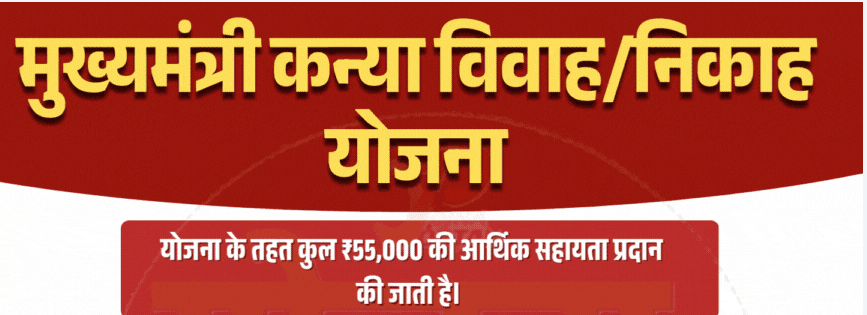

Mukhyamantri Kanya Vivah / Nikah Yojana
The Deendayal Antyodaya Mission was founded by the Madhya Pradesh government, under the Department of Social Justice and Disabled Welfare, to support the state’s poor, disabled, and weaker families while taking public opinion and involvement into account. In 2006, a program was launched under this purpose to offer financial support for the mass marriage (nikah) of impoverished, economically disadvantaged girls, widows, and divorced women. Under the name Mukhyamantri Kanya Vivah Yojana, this program was introduced.
A government-sponsored welfare program called the CM Kanya Vivah Yojna (CMKVY) was created to help females from economically disadvantaged groups marry. By guaranteeing a safe and easy marriage process, this program seeks to boost women’s dignity, advance gender equality, and lessen the financial burden on families.
Objective Mukhyamantri Kanya Vivah / Nikah Yojana
For marriageable daughters, widows, or abandoned women from families enrolled under programs for the poor, needy, destitute, and laborer categories, the Madhya Pradesh government offers financial help for their marriage or Nikbah.
Financial Assistance for Marriage: The program offers a special grant to help girls from low-income families with their wedding costs.
Promoting socioeconomic Equality: By guaranteeing that all girls have the chance to marry in a respectable manner, the program aids in closing the gap between various socioeconomic strata.
Preventing Child Marriage: By associating benefits with age verification, the program discourages child marriage and encourages marriages between people of legal age.
Women Empowerment: The program indirectly supports young women’s education and general well-being by helping with marriage-related costs.
Eligibility for Chief Minister Kanya Vivah/Nikah Scheme Application
Madhya Pradesh must be the girl’s or her guardian’s permanent home.
The girl must be at least eighteen and the groom must be at least twenty-one when they are married.
The Samagra Portal is where the name has to be registered.
Chief Minister Kanya Vivah/Nikah Scheme
At the moment, the program offers ₹55,000 in total cash support.
From this: The bride receives ₹49,000 in the form of an account payee check.
The relevant body receives ₹6,000 to organize the mass marriage ceremony.
Key Features
Financial Support: Depending on the state and particular regulations, eligible recipients may get a grant of ₹25,000 to ₹51,000. Direct Benefit Transfer (DBT): The money is sent straight to the beneficiary’s or guardian’s bank account.
Qualifications: The candidate needs to live in the state where the program is being implemented. At the time of marriage, the female must be at least eighteen years old. The household must meet certain income requirements or fall under the Below Poverty Line (BPL) category. The Marriage Registration Act requires that the marriage be registered.
- Application Mode: Depending on the state, the system permits both offline and online applications.
- Time of Disbursement: After verification, the financial aid is often credited before to or just after the wedding ceremony.
Application Process
At least 15 days before to the planned day of the mass marriage, interested parties can pick up the application form from the Janpad Panchayat office, Municipal Corporation, Municipality, or Municipal Council.
The application must be filled out completely and sent to the appropriate office with the necessary paperwork.
The selection committee will evaluate the couples’ eligibility after examining the applications, and the chosen couples will be notified of their membership in the mass marriage program.
Required Documents
The bride, groom, and their parents’ Aadhar cards Both the bride and groom’s birth certificates,
Aadhar cards, or marksheets (for age verification) The bride and groom’s Samagra ID numbers
Certificate of Caste: (if applicable) Proof of Residence Details of a single bank account in the bride’s name
Passport-sized photos of the bride and groom The mobile numbers of the bride and couple If the bride is a widow, the former husband’s death certificate If the bride is divorced, the divorce papers If you are enrolled as a laborer, a copy of your labor registration card
Important Links
| Kanya Vivah scheme | Click Here |
| Download CMKVY pdf Forms | Click Here |
| Download Unmarrid Praman patra pdf Form | Click Here |
| MP Kanya Vivah Official Webiste | Click Here |